
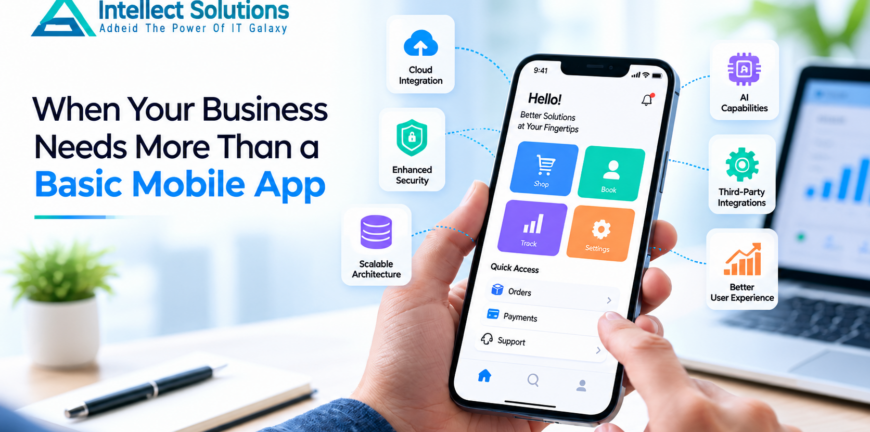
When Your Business Needs More Than a Basic Mobile App
A mobile app may begin with a simple purpose: helping customers book a service, purchase a product, access information, or interact with a business. But as the business grows, expectations from that app often change. Users now expect faster experiences, personalized interactions, intelligent search, seamless integrations, and convenient ways to complete tasks. Businesses, meanwhile, need applications that can connect with existing systems, handle growing traffic, protect sensitive information, and adapt to new technologies. This is why mobile development has moved beyond simply creating an application. A modern mobile app development company needs to consider the complete digital product, including its users, architecture, integrations, security, scalability, and long-term roadmap. Why Basic Mobile Apps Start Showing Limitations A basic application can work well when the requirements are straightforward. Problems often begin when a business starts adding more users, features, integrations, and data-driven functionality. An application that was initially created for a few simple functions may eventually need to support personalized customer experiences, real-time communication, payment systems, third-party integrations, analytics, AI-powered features, and multiple types of users. If these requirements are introduced without considering the underlying architecture, performance and maintenance can become increasingly difficult. The objective should not simply be to keep adding features. It should be to create a foundation that can support the product as the business evolves. From Mobile Apps to Intelligent Digital Products Modern mobile applications are becoming increasingly connected to AI, cloud platforms, APIs, analytics systems, and business workflows. Instead of functioning as an isolated interface, an app can become a central point where customers, employees, data, and business processes interact. For example, an application can connect customer activity with a recommendation engine, integrate real-time information from a business platform, or use AI to simplify a process that previously required several manual steps. This changes the role of a mobile application. It is no longer only a channel for accessing a service. It can become part of the way a business operates. However, adopting new technology does not automatically make an application better. The technology should be selected according to the problem the business is trying to solve. Where AI Can Actually Add Value AI is becoming an important part of mobile experiences, but not every application needs an AI chatbot or a collection of experimental features. The more useful question is where intelligence can improve the user journey or make a business process more efficient. AI can help applications understand user behavior and deliver more relevant recommendations or content. It can make search more conversational, allowing users to find information without knowing the exact terminology used within the system. It can also support predictive insights, document processing, recommendations, and repetitive workflow automation. Conversational interfaces are another growing area. Instead of navigating through multiple screens, users can describe what they need in natural language and receive an appropriate response or action. The strongest implementations are those where AI is closely connected to a genuine business requirement rather than being added simply because it is currently popular. The User Experience Still Comes First Advanced technology does not automatically create a better application. If users cannot understand where to go or how to complete an action, sophisticated backend functionality will not solve the problem. Modern app design should consider the complete user journey. Navigation, onboarding, search, notifications, forms, authentication, accessibility, and important actions should work together as one consistent experience. AI-powered features also need careful UX planning. Users should understand what an AI feature can do, what information it uses, and when they remain in control of the final action. A well-designed application makes complex technology feel simple to the person using it. Native or Cross-Platform: What Should Businesses Consider? The choice between native and cross-platform development should depend on the product rather than a universal preference. Native development for iOS or Android can be appropriate when an application requires deep platform integration, specialized device capabilities, or highly optimized performance. Cross-platform development can be useful when a business wants to serve multiple platforms while sharing a significant portion of the development code. The right decision depends on factors such as the application’s functionality, performance expectations, device requirements, integrations, maintenance needs, and long-term roadmap. An experienced development team should explain these technical trade-offs based on the actual product requirements rather than automatically recommending the same approach for every project. Security Needs to Be Part of the Architecture Mobile applications can interact with customer information, payment systems, authentication services, business databases, and third-party APIs. Security therefore needs to be considered from the beginning rather than treated as a final step before launch. Depending on the application, this can involve secure authentication, authorization, encryption, protected API communication, secure data storage, access controls, vulnerability testing, and monitoring. AI-powered applications also introduce additional considerations around how information is processed, where data is stored, what systems can access it, and how sensitive information is handled. Building these considerations into the architecture can make it easier to maintain a secure application as the product grows. Why Scalability Should Be Planned Before Launch An application that works well with a few hundred users can face very different technical demands when adoption increases. More users can mean higher API traffic, larger databases, increased server workloads, more concurrent requests, and greater demand for real-time services. Scalability should therefore be considered before the application reaches that point. A well-planned architecture can make it easier to introduce additional users, features, integrations, and services without requiring the entire application to be redesigned. This is particularly important for businesses that view their application as a long-term digital product rather than a one-time project. What a Development Partner Should Bring Beyond Coding Building a successful application involves much more than writing code. The development partner should understand the business objective, target users, product requirements, technical architecture, user experience, integrations, security, testing, deployment, and future maintenance. The discovery stage is particularly important because it helps translate a business idea into a practical product roadmap. From there, UI/UX design can establish the user journey, while architecture…