
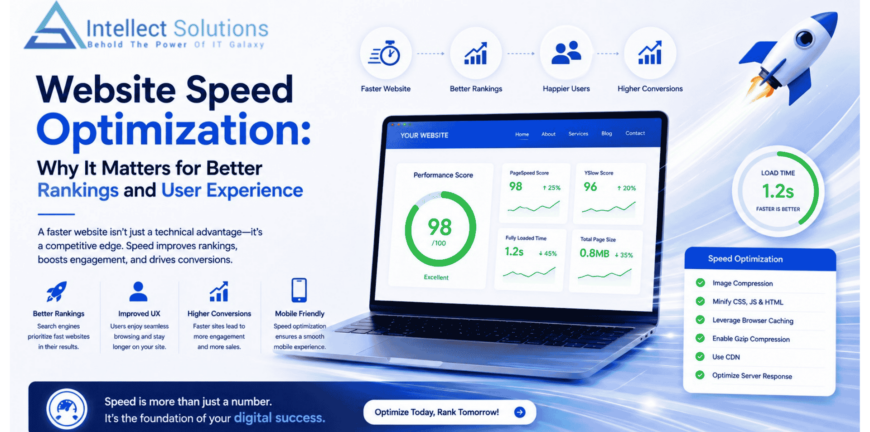
Website Speed Optimization: Why It Matters for Better Rankings and User Experience
Having a fast website isn’t a luxury anymore; it’s necessary! No matter if you’re running a business, selling products online, or just blogging, people expect your pages will load quickly. If you have an extremely slow-loading website, there is a high probability that users will leave without ever having a chance to view your site. Because of this, you could potentially lose many visitors, sales, and leads due to having a slow-loading website.
As a result, Website Speed Optimization (WSO) has become critical to success for any kind of online business (home based or otherwise) to provide better overall user experience; support higher search engine visibility; and help you achieve better overall results online as a whole. In addition, having a faster site gives your users an excellent initial impression, and keeps them engaged longer with your website.
Why Website Speed Is Important?
The speed at which your website loads directly impacts how users interact with your website. According to research, visitors expect pages to load within two seconds; if they don’t, they will leave and go to a competitor instead.
Additionally, search engines, such as Google, consider page speed to be an important ranking factor in their algorithms, so if you want to improve the performance of your website and be more visible to people searching for goods or services similar to what you are offering, then making improvements in the performance of the page will also provide an enhanced user experience for people who visit the site.
Besides those benefits, fast-loading websites provide other benefits, such as
- Lower bounce rates
- Improved search engine rankings
- More engagement with users
- Higher conversion rates
- More satisfied customers
Thus, the investment businesses of all types and sizes make in improving page load speed offers long-term value.
Common Factors That Slow Down a Website
There are several common technical issues that typically go unnoticed by webmasters, but these problems can negatively affect the overall performance of the website. The first step in resolving performance-related issues is identifying them.
Some of the most common causes of these types of issues are:
- Large, uncompressed images
- Poor quality web hosting
- More JavaScript & CSS files than necessary
- Excessive numbers of plug-ins and/or third-party scripts
- Not having a browser cache
- Un-optimized databases
- Slow responses from the web server
In addition, some of the older technologies used on your site may also slow down your pages. Proper maintenance will help minimize the likelihood that these issues will impact your visitors.
Effective Tips for Website Speed Optimization
Improving the performance of a site doesn’t necessarily require a complete overhaul. You can achieve considerable performance gains by applying established optimization strategies.
Optimize images
Large image files are among the most common causes for slow-load websites. In addition to compressing the size of any given image without impacting image quality, use modern image file formats like WebP wherever possible.
Enable browser caching
Browser caching saves website files to a user’s device for future use. Consequently, returning users will generally experience much faster page load times since their browser is not required to download the same files again and again.
Minimize the size of CSS, Javascript, and HTML files
It is possible to save space by eliminating extraneous white space, comments, and unused code from CSS, JavaScript, and HTML files, thereby enabling browsers (and users) to process your site more rapidly.
Use a content delivery network (CDN)
A CDN provides the service of distributing website content across several geographically dispersed servers. This means that when a user requests access to your site, the CDN serves the user from the nearest server, thus reducing the time necessary to download all of your site’s information.
Select a dependable web hosting service
The hosting service you select to host your website has a significant impact on website performance. Selecting high-quality hosting can improve server response time and overall server reliability.
Minimize HTTP request count
Each image, script, and style sheet creates a different HTTP request. Therefore, by combining files together and eliminating files that are not essential to your site, you can significantly improve page load times.
How Website Speed Affects SEO?
To guarantee that the user experience is the best it can be, search engines try their hardest to offer this service. Therefore, optimizing website speed can improve search engine rankings since faster sites offer better usability.
There are also essential SEO metrics that improve through website speed optimization, including:
- Core Web Vitals
- Mobile Usability
- Crawl Efficiency
- User Engagement
- Session Duration
Furthermore, lower bounce rates on faster websites provide search engines with positive signals. As speed alone cannot create high search engine ranking results, it does assist in creating an overall successful IMAP (Internet Marketing And Promotion) strategy.
Why Mobile Speed Deserves Special Attention?
A major part of people now access the internet via their mobile device. Thus, mobile performance is equally important as desktop speed.
A good mobile-friendly website will be able to load very fast, and not only can be viewed correctly on a small screen, users can navigate around the website without difficulty. By optimizing images, and reducing the number of unnecessary files and scripts, and improving the performance of the server, you are assisting the user’s experience on their mobile device.
A business that puts an emphasis on optimizing for mobile will be able to help customers stay on their website longer, which will hopefully lead to an increase in conversion rates.
Monitor Your Website Performance Regularly
You cannot just optimize your website and leave it to sit. Your website growth creates new content, plugins, and features that can impact load times. It is essential to perform continual performance testing so that you can find problems before users experience them. Some popular tools for performance measurement are Google PageSpeed Insights, GTmetrix, and Lighthouse. These tools provide many valuable recommendations for making continual improvements.
Another way many companies can perform continual website performance optimization is by using a professional services firm, such as SAIntellect Solutions, which provides qualified experts to help identify technical problems and implement long-term optimization strategies. This ensures that your web pages remain fast, safe, and search engine friendly.
Conclusion
Visitors have a better experience when websites load quickly. This results in improved search engine rankings and increased conversion rates. Improving image optimization, developing efficient code, providing reliable hosting, utilizing browser caching, and consistently monitoring your websites is key to ensuring optimal performance across multiple devices.
Website Speed Optimization provides long-term value for both small business websites and large-scale enterprise websites. To improve performance, enhance user experience, and drive sustainable growth for your business, SAIntellect Solutions provides professional web optimization services.
Get Expert Help Today
Are you experiencing diminishing traffic on your site due to slow loading times? Poor performance can negatively impact both your ranking and your customers. Don’t languish in low-performance-sites hell any longer. Contact SAIntellect Solutions for a complete website speed audit and an effective optimization strategy today! We will work with you to create an incredibly fast, highly functional website that generates improved results for your organisation.
FAQs
1. What is Website Speed Optimization?
Website Speed Optimization is the process of improving a website’s loading time by optimizing images, code, hosting, caching, and other technical elements to enhance user experience and SEO performance.
2. Why is website speed important for SEO?
Search engines consider page speed as one of the ranking factors. Faster websites improve user experience, reduce bounce rates, and support better search visibility.
3. How can I check my website’s speed?
You can use free tools such as Google PageSpeed Insights, GTmetrix, and Lighthouse to analyze your website’s performance and identify areas for improvement.
4. How often should I optimize my website?
It is recommended to monitor your website regularly and perform optimization whenever new features, plugins, or content are added to maintain consistent performance.
5. Can professional website optimization improve conversions?
Yes. Faster websites provide a smoother user experience, encourage visitors to stay longer, and often lead to higher engagement, increased leads, and improved conversion rates.